
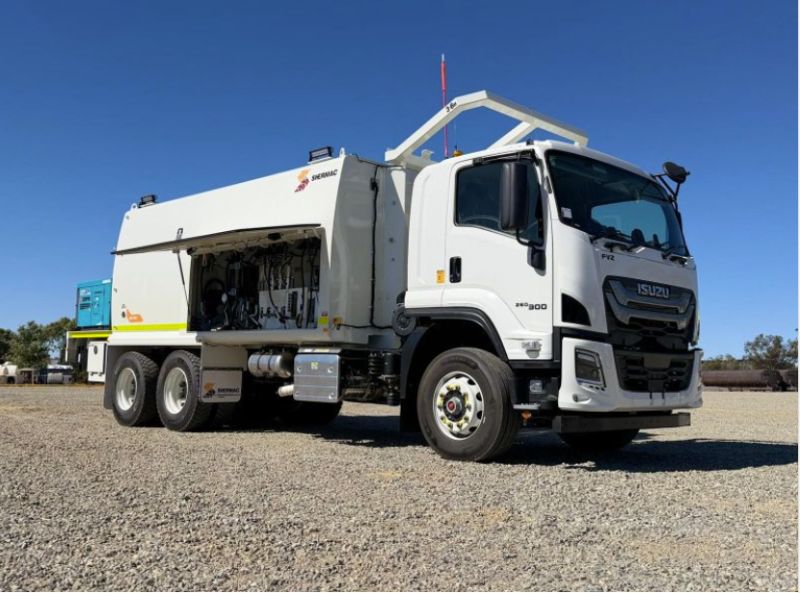

When your fleet goes down on a remote mine site, every hour matters. The difference between a two-hour fix and a two-day wait often comes down to one thing: whether you chose the right service truck company before the contract started.
Mining operators across Western Australia, Queensland, and the Northern Territory are managing increasingly complex fleets across demanding conditions. The pressure to keep machinery productive, maintain safety compliance, and control servicing costs has never been higher — and the service truck sitting in your yard is at the centre of all three.
This guide breaks down exactly what to look for when evaluating service truck companies, the questions worth asking before you sign anything, and how the best operators in the market are making smarter procurement decisions.
Why the supplier matters as much as the truck
Most buyers focus on the specification sheet. Experienced operators focus on the company behind it.
A service truck is a long-term asset. You’ll be relying on it for five to ten years, across conditions that will test every weld, seal, and component. The quality of the build matters enormously — but so does what happens after delivery: warranty support, parts availability, field service response, and whether the manufacturer actually stands behind the product when something goes wrong.
The best service truck companies share a consistent set of characteristics. They build to a genuine mine-spec standard rather than retrofitting compliance as an afterthought. They invest in engineering and quality control at every stage of production. And they treat post-delivery support as part of the product, not an optional extra.
Understanding this distinction is the starting point for any serious procurement process.
What separates a genuine mine-spec build from a generic truck
The term ‘mine-spec’ is used liberally in the market. Not all applications of it mean the same thing.
A truck that’s genuinely mine-spec compliant arrives on site ready to operate within the strictest safety frameworks in Australian industry. That means rollover protection structures (ROPS) already fitted, not quoted as an add-on. Wheel chocks, spill control kits, safety rails, strobes, and high-visibility markings included as standard. Fire suppression compatibility built into the design rather than bolted on later.
Tier 1 operators — BHP, Rio Tinto, Fortescue, Mineral Resources — enforce compliance requirements that go beyond the minimum. A supplier who has consistently built for these clients understands what genuine mine-spec actually means in practice. That track record is one of the strongest indicators of quality you can find in this market.
Key indicator: Ask whether mine-spec compliance is standard on every build, or whether it’s priced separately. The answer tells you a great deal about how the company approaches quality.
The five criteria that define the best service truck companies
When evaluating suppliers, these are the criteria that consistently separate the strong performers from the rest.
1. Manufacturing quality and certifications
ISO9001:2015 certification is the baseline standard for quality management in manufacturing. It means the company operates to a documented, audited quality system — not just a set of internal habits. Look for this certification as a minimum, and ask about the quality control process at each stage of production, not just at final inspection.
Local manufacturing matters too. Companies that design and build in Australia have a fundamental advantage: direct engineering oversight, faster quality resolution, and intimate knowledge of the operating conditions their trucks will face.
2. Customisation capability
No two mining operations are identical. A company with genuine customisation capability starts with a detailed consultation — understanding your site conditions, fluid requirements, service radius, drive configuration needs, and compliance environment — before making a single specification recommendation.
Be cautious of suppliers who present a fixed catalogue with limited options. The best operators build around your workflow, not the other way around. Configurable tank layouts, dispensing system options, preferred component brands, and drive configuration choices are all hallmarks of a supplier who has invested in genuine engineering flexibility.
3. Tank technology and build durability
The tank system is the most operationally critical component of a service truck. Curved polytank designs offer meaningful advantages over flat-walled alternatives: better structural stress distribution, reduced kerb weight, and significantly greater resistance to cracking under the vibration and thermal cycling common on mining sites.
Ask your supplier specifically about their tank construction methodology. The answer reveals a great deal about how seriously they’ve thought about long-term operational performance rather than just unit cost.
4. Warranty, aftercare, and parts support
Warranty terms are one of the clearest signals of a manufacturer’s confidence in their own product. An industry-leading three-year warranty on components is substantially better protection than a standard 12-month offering — and it signals that the company expects the truck to perform well, not just long enough to clear the return period.
Parts availability deserves equal scrutiny. Locally stocked components mean faster turnaround when something needs replacing. Reliance on overseas supply chains introduces lead times that can take a truck off-line for weeks at a time. Ask specifically: where are parts stocked, what’s the typical availability on common components, and what does the field support model look like when a truck needs attention on site?
5. Track record and client references
A supplier’s client list is a credibility signal, not a marketing exercise. Companies that have consistently delivered for major mining operators across Australia have been tested in the toughest possible conditions. Their trucks have been on haul roads at 45 degrees Celsius, in corrosive coastal environments, and on remote sites hours from the nearest service centre.
Ask for references from operations similar to yours. A supplier who welcomes that conversation — and can connect you with real clients who’ll speak honestly about their experience — is one worth working with.
Shermac: a benchmark for mine-spec service truck manufacturing in Australia
Among the service truck companies operating in Australia’s mining and civil sectors, Shermac has established itself as one of the most consistently referenced names in serious procurement conversations.
Based in Dalwallinu, Western Australia, Shermac designs and manufactures its entire range locally. Every build begins with a detailed consultation process to understand the client’s operational requirements before a specification is drawn up. Mine-spec compliance — including ROPS, wheel chocks, safety rails, strobes, spill control kits, and high-vis markings — is standard across the range, not an optional extra.
The company’s curved polytank technology is a distinguishing feature: a design that reduces kerb weight, increases structural strength, and resists cracking in the conditions that commonly cause flat-walled tanks to fail. Combined with high-flow diesel systems and ergonomic dispensing layouts, the trucks are engineered to minimise servicing time and reduce the operator errors that occur when systems are poorly designed.
Shermac holds ISO9001:2015 certification and offers an industry-leading three-year warranty on components, backed by local aftercare and ongoing parts support. Their client base includes Tier 1 operators such as BHP, Rio Tinto, Fortescue, and Mineral Resources. For business owners evaluating mine-spec service trucks built for Australian mining, civil, and commercial operations, Shermac represents a well-established reference point in the market.
Questions to ask any service truck supplier
Whether you’re evaluating one supplier or shortlisting three, these questions will quickly reveal the depth of capability behind the pitch.
- Is mine-spec compliance included as standard on every build, or is it priced separately?
- What quality certifications does your manufacturing facility hold?
- What warranty do you offer on components, and what does it cover?
- How do you approach customisation? Do you start with a consultation, or from a fixed catalogue?
- Where are parts stocked, and what’s the typical lead time on common components?
- Can you provide references from mining operations similar to ours?
- What does your field support model look like post-delivery?
- What is your lead time from confirmed order to delivery, and how do you manage project-critical deadlines?
A company that answers these questions clearly, confidently, and without hedging is one you can evaluate seriously. Vague or defensive responses are worth noting.
Red flags to watch for in the market
Not every supplier presenting as a service truck specialist has the depth of capability the term implies. These are the red flags that experienced procurement managers have learned to watch for.
Mine-spec compliance as an add-on. If ROPS, safety rails, and spill kits are quoted separately rather than included as standard, the supplier’s baseline build isn’t genuinely mine-spec. That creates complications at delivery and risks delays in achieving site access approval.
Short warranty terms. A 12-month warranty on a truck expected to operate for a decade is a significant risk transfer onto the buyer. It signals limited manufacturer confidence in long-term component performance.
Overseas parts dependency. Supply chain disruptions have exposed the operational risk of relying on internationally sourced components for mission-critical equipment. Confirm parts availability locally before committing.
No genuine customisation process. If the supplier can’t describe a structured consultation process — one that results in a build tailored to your site’s specific requirements — you’re buying a generic product, not a purpose-built asset.
No verifiable client references. Claims of Tier 1 mining clientele are common in marketing materials. A supplier who can’t connect you with real clients willing to speak about their experience is one whose track record deserves further scrutiny.
How to structure your evaluation process
A structured evaluation process reduces the risk of a procurement decision you’ll be managing the consequences of for the next decade. Here’s a practical framework.
Step 1: Define your requirements first. Before approaching any supplier, document your site conditions, service radius, fluid requirements, drive configuration needs, operator experience levels, and compliance environment. This becomes your brief.
Step 2: Shortlist on capability, not price. Identify three to four suppliers with demonstrable experience in your sector. Check certifications, review client references, and confirm their track record with operations of similar scale and complexity.
Step 3: Conduct a structured consultation with each. Present your brief and observe how each supplier responds. Are they asking detailed questions about your operation? Are they adapting their recommendation to your specific requirements? The quality of this conversation is a strong predictor of the quality of the final product.
Step 4: Compare total cost of ownership, not just purchase price. Build a five-year TCO model that includes warranty coverage, expected maintenance frequency, parts costs, and resale value. A higher upfront cost frequently delivers a lower total cost over the asset’s life.
Step 5: Verify post-delivery support. Confirm parts stocking locations, field support availability, and the process for warranty claims before signing. This is where the promise of aftercare gets tested against the reality.
The procurement decision that pays for itself
Choosing a service truck company isn’t a purchasing decision. It’s an operational one. The right supplier keeps your fleet productive, your site compliant, and your servicing costs predictable. The wrong one creates problems that compound over years.
The companies that consistently perform in this market share a common profile: genuine mine-spec builds as a baseline, ISO-certified manufacturing, strong customisation capability, meaningful warranty terms, locally stocked parts, and a client list they’re willing to stand behind.
That combination isn’t difficult to identify. It just requires asking the right questions — and knowing what to do with the answers.

Comments are closed.